

Last Update: 29 September 2026
New investors receive a €5 sign-up bonus after registration. To keep the bonus, at least €50 must be deposited within 30 days. The bonus is locked for the first 30 days. I am invested with my own funds at Bondora since June 2018. Since then, I achieved a total return (XIRR) of 6,32%. My outstanding portfolio on the platform stands at 26.622 €. Bondora is an Estonian P2P lending platform that was founded in March 2008. Given its long operating history, the company is one of the oldest, most experienced, and most crisis-tested P2P platforms in Europe. Over the years, Bondora has also established a dominant market position. Measured by metrics such as assets under management and the number of registered investors, only Mintos has a larger market share within the European P2P lending industry. One of Bondora’s greatest strengths is its financial stability. The company has remained consistently profitable since 2017, while its balance sheet metrics rank among the strongest in the entire industry. More details can be found later in my Bondora Go & Grow review. A few words about the business model: Bondora’s core business consists of financing unsecured consumer loans within the European Economic Area, with loan terms of up to 60 months. Its primary borrower markets are Estonia and Finland. Through its recent expansion efforts, the Netherlands, Denmark, and Latvia have also been added to the portfolio. Investors can gain exposure to Bondora’s managed loan portfolio through the “Go & Grow” product, which was introduced in 2018. In return, investors receive a 6% annual return and the ability to withdraw funds from their Bondora account on a daily basis. It should be noted that Bondora currently operates as an investment platform without a product-specific regulatory license. What this means in practice for investors, and which risk factors should be considered, will be discussed in more detail later in this review. There have been two in-person meetings with the Bondora team in Tallinn. The first took place in October 2018, the second in May 2024. On both occasions, I had the opportunity to speak with Bondora founder and CEO Pärtel Tomberg. The 2024 conversation was particularly substantive, covering topics such as the lack of transparency around Go & Grow, the performance of the loan portfolio and the company’s plans to obtain a banking licence. The full interview can be viewed here. The key features of Bondora Go & Grow include a predefined target return of 6% per year, daily interest accrual, ease of use, high liquidity (daily withdrawals under normal market conditions), and broad diversification across more than 100,000 borrowers. Due to its structure, Bondora Go & Grow is particularly suitable for two types of investors: With the launch of Go & Grow, Bondora set new standards in the industry, particularly in terms of simplicity and liquidity. It is no coincidence that many platforms have since attempted to launch similar products, often without success. Examples include Mintos Invest & Access and Crowdestor Flex. Among the strongest current alternatives to Go & Grow are Monefit SmartSaver and TWINO FLEXI. One point that deserves criticism is that Bondora Go & Grow does not publish performance-related metrics regarding the quality of the underlying loan portfolio. Further discussion of this issue follows in the risk section. All key facts and figures about Bondora Go & Grow at a glance. P2P lending is a dynamic asset class where investors should stay continuously informed. You will find the latest news on Bondora Go & Grow on my P2P lending news page, where I cover other P2P platforms as well. Bondora has introduced a new product called Go & Grow Pocket. It works as a separate product alongside the regular Go & Grow account, offering an expected return of 4.89% per year. The key selling point of Go & Grow Pocket is an insurance coverage of up to €25,000 through Balcia Insurance SE. This is an insurance policy, not statutory deposit protection. For context: The coverage only applies in the event of a defined insured event and is subject to the terms, coverage limits, and exclusions of the policy. However, these insurance terms have not yet been published, as they are still being finalized with Balcia. Bondora has published its long-awaited 2025 Annual Report, once again audited by KPMG and prepared in accordance with IFRS standards. The figures are highly impressive. Revenue increased by 19% to EUR 62.7 million, the loan portfolio grew by 16% to EUR 697 million, and net profit almost eightfold to a record EUR 9.5 million. The balance sheet remains equally strong. The equity ratio (74.7%), debt ratio (0.34), and liquidity ratio (3.18) are all within strong and healthy levels. The exceptional increase in profit – and consequently some of the financial ratios – have been supported by a one-off transaction with Bondora selling a portfolio of non-performing Finnish loans to an institutional investor. While a part of the purchase price will only be received over the next three years (recorded as a EUR 2.65 million long-term receivable on the balance sheet), Bondora appears to have already credited investors with the full amount of the sale proceeds. The annual report does not disclose how much this one-off transaction contributed to the group's total profit. This should not diminish Bondora's achievement, but without knowing the exact size of the one-off effect, it is impossible to determine the company's underlying recurring earnings with precision. Alternatively, you can subscribe to my Telegram channel or WhatsApp group (both free of charge) to receive real-time updates as soon as new developments emerge. Since June 2026, Go & Grow has been owned by Go&Grow Holding AS, in which Bondora founder Pärtel Tomberg is the largest single shareholder with around 29% through his company Tomberg Management & Consulting. Further stakes are held by the German venture capital investor Global Founders and a Swiss nominee account, among others. How ownership and leadership are structured following the spin-off from Bondora Group is something I examine in the next sections of my Bondora Go & Grow review. Go&Grow OÜ, which operates the product, has been wholly owned by Go&Grow Holding AS since 30 June 2026. The holding company itself was entered into the register on 2 June 2026. Before that, Go&Grow OÜ belonged to Bondora Group AS. The legal separation from the Bondora group was therefore only completed at the end of June, even though the change was announced back in April. Around one third of the shares are held by shareholders below the 10 percent threshold and are not listed individually in the register. The second largest position, at 13.87%, is held through a nominee account of Switzerland’s SIX SIS AG, the Swiss central securities depository. Who ultimately owns these shares is not evident from the Estonian register. As of the time of review (August 2026), the beneficial ownership details for the holding company had not yet been filed. Since 2 June 2026, the management board of Go&Grow Holding AS has consisted of Pärtel Tomberg, Triin Sarapuu and Krzysztof Sebastian Schmidt. It was during this period that the idea of building a lending marketplace based in Estonia took shape. After several entrepreneurial ventures at a young age, he founded the P2P platform known today as Bondora in 2008, and remains its CEO to this day. The spin-off of Go & Grow has strengthened his position further. Through his company Tomberg Management & Consulting OÜ he holds around 29% of Go&Grow Holding AS, making him the largest single shareholder. At the same time, he sits on the management board. Ownership and leadership therefore rest in the same hands, giving him a strong position within the company. To invest in Bondora Go & Grow, investors must meet two requirements: They must be at least 18 years old and reside in the European Union, Norway, or Switzerland. The registration process is designed to be intuitive and can usually be completed within just a few minutes. Once the verification has been approved, investors can deposit funds and start investing in Bondora Go & Grow immediately. New investors receive a €5 sign-up bonus after registration. To keep the bonus, at least €50 must be deposited within 30 days. The bonus is locked for the first 30 days. Investors looking for a comprehensive overview of all available sign-up bonuses and cashback promotions across different platforms can find them on the bonus page. To understand how investing on Bondora Go & Grow works is fairly easy and simple. The following steps outline the key process. Through the “Goals” section, investors can define their investment objectives. Users can set a name, a target amount, and optionally a target date to track progress. Funds can then be allocated to individual goals accordingly. After the launch of Bondora Go & Grow, investors were able to achieve a targeted annual return of 6.75%. In April 2025, the target return was adjusted to 6% p.a. Throughout its entire history, the advertised return has been achieved for all investors. In August 2026, Bondora introduced Go & Grow Pocket as a second investment product. It works as a separate pot alongside the regular Go & Grow account, with an expected return of 4.89% p.a. instead of 6%. The return discount of more than one percentage point is the price for the central marketing promise, namely insurance coverage of up to 25,000 euros through the Latvian insurer Balcia Insurance SE. An important clarification: this is an insurance policy, not a statutory deposit guarantee. The cover only applies in the event of a defined insured event and is subject to the coverage limits and exclusions of the policy. The policy terms, however, have not yet been published. This means the core of the product promise cannot currently be verified. In particular, it remains unclear which events are actually covered. With Pocket, investors are therefore trading a certain reduction in returns for protection whose scope is not yet known. In September 2020, Bondora introduced a monthly deposit limit for its Go & Grow product. This measure was implemented in response to significant volatility in deposits and withdrawals following the outbreak of the COVID-19 pandemic. The introduction of the deposit cap meant that investors needed considerably more time to build a larger position in the product. As a result, this artificial scarcity led to a higher perceived value of the product among investors. At the same time, it provided Bondora with a more stable planning horizon for balancing loan supply and investor demand. The monthly deposit limit was EUR 1,000 until September 8, 2024. This limit represented the sixth adjustment since its original introduction. On September 9, 2024, Bondora announced a temporary removal of the deposit limit. Since then, the deposit limit has remained lifted to this day. With Go and Grow, investors invest in the loan portfolio of the Bondora Group, which is active across Europe with various lenders. This includes countries such as Estonia, Finland, the Netherlands, Denmark, and Latvia. As an investor, you can think of it like an investment fund with more than 100,000 loans. There are no publicly available statistics regarding the assets managed by Bondora Go & Grow or the exact performance of the loan portfolio. For this reason, Go & Grow has a sort of “black box” nature, making a precise risk assessment difficult. The only information regarding the quality of the loan portfolio is provided to investors in the form of breakdowns by borrower country and risk rating. These results are published intermittently on the blog. Looking at the percentage distribution of risk ratings, it appears that Bondora has followed a rather conservative approach to lending over the years. Generally, withdrawals from Bondora Go and Grow can be made instantly and in full amount. Hence, there are no withdrawal restrictions. However, the liduidity is dependent on certain market situations. During the peak of the COVID-19 crisis, Bondora had to temporarily introduce partial payouts between March 2020 and June 2020 due to the high volume of withdrawal requests. If money is withdrawn from Bondora Go and Grow, the Estonian P2P platform charges a flat withdrawal fee of EUR 1. Currently, there are no costs or hidden fees for managing the Go & Grow investment on Bondora. Only a fee of EUR 1 per withdrawal is charged. How is the income from Bondora Go & Grow taxed? There are different opinions and experiences among P2P investors on this popular and frequently asked question. In general, income generated through P2P loans must be taxed as interest income. With Bondora Go & Grow, the situation is somewhat different. The platform itself writes: You only pay tax on the money you withdraw which is over the total amount you have paid in. For example, if you invest €1,000 then anything you withdraw up to €1,000 is considered as a principal withdrawal, anything above €1,000 is considered as interest. In plain terms: If you do not withdraw more money than you originally invested, you have not realized any profits and therefore do not need to pay taxes. This is also referred to as alternative taxation. According to the platform’s evaluation, Bondora Go & Grow is considered a tax-optimized investment product, allowing compound interest to work effectively. Whether the tax-optimized model applies should be discussed with a tax advisor or directly with the tax office in each individual case. Investors can download a tax report under the “Go & Grow Tax Report” section in the settings. Anyone looking to invest in Bondora Go & Grow must be aware of the risks associated with the investment product. But what are these risks? And how can they be assessed? More details are provided in the following sections. Since April 2026, Go & Grow has been operated by the independent company “Go&Grow OÜ”, following its spin-off from the Bondora Group. For investors, nothing changes operationally for the time being. In its domestic market Estonia, the platform is not subject to any supervision or oversight by a financial authority. There is neither an investor compensation scheme nor any regulatory requirement for compliance or transparency standards. As a product without its own regulatory licence, trust in the underlying corporate group is a key risk factor. What speaks in favour of Go & Grow is its long-standing association with the Bondora Group, the group’s consistently profitable business development and its KPMG-audited financial reports. No Red Flags present. All funds deposited into Go & Grow are automatically invested in loans. A wallet function with unallocated balances no longer exists. All investor funds are held in segregated client accounts with AS LHV Pank, a subsidiary of Estonia’s largest domestic financial institution. Funds are therefore kept separate from the platform’s own operating funds. Individual IBANs for investors are not provided. Incoming payments are matched using reference numbers and verified bank accounts. Unlike traditional bank deposits, there is no entitlement to compensation through a deposit guarantee scheme. Investors should therefore be aware that invested capital is subject to a real risk of loss, that returns are not guaranteed and that it may not be possible to recover the full amount invested. Since the launch of Go & Grow Pocket, Bondora has additionally been advertising insurance cover of up to 25,000 euros. However, this applies exclusively to the Pocket product, not to the regular Go & Grow account. An insurance policy also differs fundamentally from a statutory deposit guarantee: it is a private contract with defined coverage limits, exclusions and a narrowly defined insured event, whereas a deposit guarantee is a statutory entitlement. As long as the terms remain unpublished, the extent of the protection cannot be assessed. In the past, Bondora has had to navigate several crisis situations, including the COVID-19 pandemic and the war in Ukraine. COVID-19 Pandemic: Bondora responded early to the outbreak of the pandemic by significantly reducing new loan issuance. In Spain and Finland, lending activities were even suspended entirely for several months. This conservative approach proved financially beneficial: In 2020, Bondora reported a net profit of EUR 3.4 million, making it the strongest financial year in the platform’s history at that time. War in Ukraine: Since Bondora’s lending markets are located outside the affected war zone, the conflict had no direct impact on the platform. According to Bondora, there were no operational disruptions related to the war in Ukraine at any point. The financial stability of a P2P platform is a key risk factor. Is Bondora already able to operate profitably? And what conclusions can be drawn from the balance sheet? Annual Report Auditor: KPMG Baltics Established and independent audit firm (Top 10 worldwide). Standard: IFRS Internationally recognised standard. Transparent and comparable. The following figures are based on the Bondora Group annual report for 2025. The report was prepared by KPMG Baltics and audited in accordance with IFRS standards. The figures therefore carry a certain degree of credibility. Bondora increased its revenue by 19% to EUR 62.7 million during the 2025 financial year. At the same time, its loan portfolio grew by 16% to EUR 697 million, while net profit almost eightfold to a record EUR 9.5 million. As a result, Bondora Group AS, the parent company behind the Bondora platform, has now remained profitable since 2017. The balance sheet remains equally strong. The equity ratio (74.7%), debt ratio (0.34), and liquidity ratio (3.18) are all within strong and healthy levels. For a long time, the Bondora statistics, which cover all loans since 2008, showed a negative trend in the overall performance of the loan portfolio. By early 2025, the performance of the Bondora loan portfolio was below the initial return of 6.75%, which had been offered to Go & Grow investors from the start. A petition I started, which advocated for transparent reporting of the Go & Grow loan portfolio, was rejected by Bondora. As a result, important questions regarding the transparency and return of Go & Grow remain unanswered. Liquidity risk should also be taken into account, as Bondora heavily markets Go & Grow based on the daily availability of invested funds. However, this promise has not always been fully upheld in the past. At the beginning of the COVID-19 pandemic, demand for withdrawals increased so significantly that the platform had to introduce temporary partial payouts between March 2020 and June 2020. The reserves of the Go & Grow loan portfolio were therefore not sufficient to maintain the promise of daily liquidity at all times. Investors should thus be aware of the risk that daily liquidity can only be guaranteed under certain market conditions. Loan defaults are part of the daily business of any P2P lending platform. Since Bondora Go & Grow investors have no protection or guarantees for the advertised return, it’s worth taking a closer look at the debt collection and recovery process, which at Bondora consists of four phases: According to Bondora, about 31% to 54% of the defaulted principal is recovered within three years, depending on the country. On average, the amount recovered from a defaulted EUR 1,000 loan is between EUR 667 and EUR 689. In July 2025, Bondora published a breakdown of the currently defaulted loans and the phase they are in. In established markets like Estonia and Finland, 54% and 66% of loans, respectively, are already at the bailiff stage, meaning the final phase of the collection process. In the Netherlands, a newer market, 75% of loans are still with the collection agency. Recovery prospects are considered particularly low in Estonia, where 23% of defaulted loans are classified as unlikely to be recovered. In contrast, the outlook is significantly more optimistic in Latvia, where only 3% of loans are considered unlikely to be recovered. In this section, I have listed what I consider to be the most important advantages and disadvantages of Bondora Go & Grow. Launching in 2018, Bondora Go & Grow has set new standards in terms of fixed returns, ease of use, high liquidity, and broad diversification. In particular, the combination of simplicity and high liquidity makes Go & Grow a good option for two types of investors: With the exception of a three-month period following the outbreak of the Covid-19 pandemic, the platform has consistently maintained daily liquidity since 2018. Despite this strong track record, it is clear that liquidity can be limited in exceptional situations. Apart from liquidity, investors should also pay close attention to the underlying risks related to transparency and returns, which are discussed in detail in these Go & Grow review. Those with a long-term investment horizon will find stronger alternatives within the P2P lending space in terms of expected returns and risk mitigation. Personally, I used Bondora Go & Grow as an active investor between June 2018 and August 2023, and again starting in January 2025. During this time, I earned more than EUR 7,000 in interest. Do you also want to try Bondora Go & Grow? Then register now by using the link below. New investors receive a €5 sign-up bonus after registration. To keep the bonus, at least €50 must be deposited within 30 days. The bonus is locked for the first 30 days. Are you already invested in Bondora Go & Grow and looking for similar alternatives with high liquidity? In the current market environment, the closest Go & Grow alternatives are Monefit SmartSaver, TWINO FLEXI, and Modena. The following table is intended to illustrate the similarities and differences between these products. Additional Bondora Go & Grow alternatives can be found in my P2P platform comparison. Bondora Go & Grow is an investment product by the Estonian P2P platform Bondora, launched in April 2018. It promises a fixed return of 6% p.a., daily liquidity, and simple operation without any manual loan selection. Currently 6% p.a. with daily interest accrual. Between April 2018 and April 2025, the return was 6.75%. Bondora can adjust the interest rate at any time and it is not guaranteed. Personally, I have earned more than €7,000 in interest since 2018. Bondora is unregulated and offers no deposit protection. The long track record since 2008, continuous profitability since 2017, and audited financial reports support the platform’s stability. Nevertheless, invested capital is subject to real loss risk. Bondora advertises daily liquidity. With the exception of a period of almost three months following the outbreak of the COVID-19 pandemic in 2020, this promise has been fulfilled since April 2018. Partial payouts cannot be ruled out in exceptional circumstances. Partly. Terms, notice periods, and daily availability are comparable. The 6% return is significantly higher than typical savings account rates. The key difference: savings accounts in Germany are protected by deposit insurance up to €100,000, while Bondora Go & Grow is not. I’m Denny Neidhardt, the founder of re:think P2P. On this blog, I help retail investors make smarter, well-informed investment decisions in the world of P2P lending. Since 2019, I’ve been publishing in-depth analyses, platform reviews, and risk assessments to bring more transparency to this investment space. My goal is to challenge marketing claims, question developments, and empower investors with honest, independent insights.
What is Bondora?
Bondora On-Site Visit
What is Bondora Go & Grow?
 Bondora Go & Grow is an investment product that is offered by the previously introduced P2P lending platform Bondora. The first investors were able to test Go & Grow as early as April 2018, while the product was officially launched and made available to all investors in June 2018.
Bondora Go & Grow at a Glance
Operational Launch:
2008 (Bondora) / April 2018 (Go & Grow)
Legal Name:
Go&Grow OÜ (LINK)
Headquarter:
Tallinn, Estonia
Regulated:
No
CEO:
Pärtel Tomberg (December 2007)
Assets Under Management:
EUR 786+ million
Number of Investors:
514,000+
Expected Return:
Up to 6%
Risk Score:
5.5 / 10 (Rank 19 of 31) | View Methodology
Primary Loan Type:
Consumer Loans
Collateral:
No
Bondora Go and Grow News


Shareholders and Management
Shareholders

Management
 Pärtel Tomberg is the founder and the face of Bondora. Born in Estonia and raised in Tallinn with three siblings, Tomberg moved to the United Kingdom at the age of 17 to study. Three years later he graduated from Oxford Brookes University with a degree in International Business Management.
Registration and Bonus
Bondora Go & Grow Bonus
Bondora Go & Grow – How It Works
Goals
Return
Go & Grow Pocket
Go & Grow Deposit Limit

Loan Portfolio

Withdrawals
Fees
Bondora Go & Grow Taxes
Go & Grow Tax Report

Bondora Go & Grow Risk
Platform Risk
Red Flags 0
Segregation of Funds and Deposit Protection
Bondora in Crisis Situations
 From an operational perspective, Bondora Go & Grow experienced liquidity constraints for almost three months. Due to insufficient cash reserves, partial withdrawals were temporarily introduced. As a consequence, Bondora later implemented a monthly deposit limit for Go & Grow in order to better balance supply and demand.
Financial Stability
Profitability
Balance Sheet
The exceptional increase in profit – and consequently some of the financial ratios – have been supported by a one-off transaction with Bondora selling a portfolio of non-performing Finnish loans to an institutional investor. While a part of the purchase price will only be received over the next three years (recorded as a EUR 2.65 million long-term receivable on the balance sheet), Bondora appears to have already credited investors with the full amount of the sale proceeds.
The annual report does not disclose how much this one-off transaction contributed to the group’s total profit. Without knowing the exact size of the one-off effect, it is impossible to determine the company’s underlying recurring earnings with precision.
Return Risk
 Bondora promotes Go & Grow with a return of 6%. In order for this return to be sustainably paid out to investors, it must be generated by the loan portfolio. Otherwise, the system behind Go & Grow will eventually collapse. How should this risk be assessed?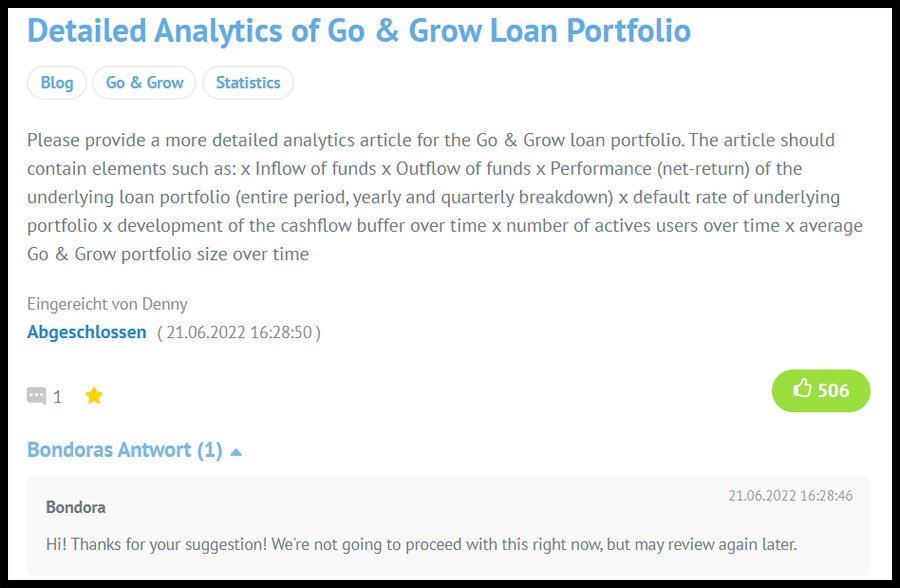
Liquidity Risk
Loan Default Risk

Advantages and Disadvantages
Summary Bondora Go and Grow Review
 What is the final conclusion of this Bondora Go & Grow review? Is the Estonian investment product worth a try?
first, for new and more inexperienced investors who want to start investing in P2P loans quickly and easily; and second, for investors with a strong need for liquidity who want to invest their money short-term at an attractive interest rate.
Bondora Go and Grow Alternatives
Criterion
Go & Grow
SmartSaver
FLEXI
Modena
Launch
2018
2022
2026
2025
Jurisdiction
Estonia
Estonia
Latvia
Estonia
Return
6%
7.5%
6%
Up to 11%
Interest Credit
Daily
Daily
Daily
Monthly
Liquidity
Daily
Max. 10 Days
Daily
Max. 31 Days
Min. Investment
EUR 1
EUR 10
EUR 10
EUR 50
Max. Investment
No Limit
EUR 500,000
EUR 10,000
No Limit
Regulation
No
No
Yes
No
Collateral
No
No
No
No
FAQ Bondora Go & Grow Review

I started using Bondora Go & Grow 4 years ago. I use different other P2P platforms as well. Bondora feels as one of the safest and most stable options, and offers an intuitive, user-friendly interface and investment experience and, as I experienced first-hand, a helpful and responsive customer service.
While the interest rate is lower than on other platforms, the big advantage is that the entire amount can be withdrawn instantly when needed. I needed the money in 2022 when making a real estate purchase, and had the entire amount on my bank account the next day. This convinced me to add funds to my account on Bondora again as soon as I had money available, and since then it’s again a worry-free passive investment where I see my money growing literally every day.
Hi Cedric,
thanks for contributing to my Bondora Go & Grow review by sharing your extensive opinion. If you value liquidity, then Go & Grow is indeed a great option. Even at the expense of a lower interest rate.
Kind Regards,
Denny
I understand the interest is low, but for high liquidity, short period, I think we can considere Bondora as a great option. Especially in order to avoid some cash drags when we compare with other P2P platforms.
Hi Thiago,
thanks for contributing to my Bondora Go & Grow review by sharing your opinion.
Kind Regards,
Denny
I find the platform very beginner friendly and a good choise for someone who want to begin his investment journey. The daily accumulation of interest makes it quite handy for your first steps in the space.
Hi Michail,
thanks for contributing to my Bondora Go & Grow review by sharing your opinion. I agree that the product is an easy entrance for less experienced P2P investors. How do you see the recent interest rate change to 6%?
Kind Regards,
Denny