
 Posted by
 Looking back on 2025, I have chosen Nectaro as the best P2P platform of the past year. The reason is not only the strong return of 17.5% that I have been able to achieve since I started investing 12 months ago, but also the overall positive development of the Latvia-based platform.
Although Nectaro only completed its second full operational year in 2025, the Latvia-licensed P2P platform managed to impress across the board.
- Competitive interest rates from profitable lenders
- Attractive bonus campaigns to boost returns
- Integration of an auto-invest function
- Introduction of a group guarantee for Abele Finance
- Open communication and a high transparency standard
As a result, the investor assets managed on Nectaro grew from EUR 3.6 million to just under EUR 20 million in 2025, with a default rate of 0%.
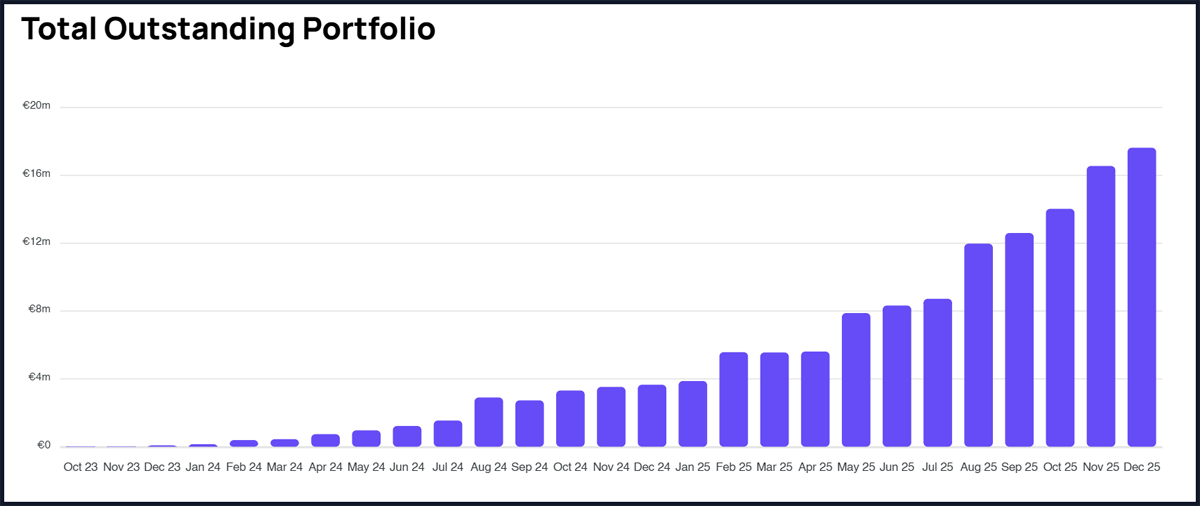
As beautiful as this snapshot is, it is equally logical that things cannot continue in this form forever. At least not if Nectaro still intends to keep growing in the future. That, however, requires a new strategy and new structures.
The question that therefore arises: Can Nectaro still promise high returns in 2026, if at the same time more security and liquidity are being demanded?
That is exactly what I recently discussed with Nectaro CEO Sigita Kotlere.
In this article, I will explain my personal investment strategy at Nectaro, how I was able to achieve an above-average return last year, and how sustainable I consider this approach to be.
There is also an outlook on some topics that will be in focus for 2026. These include considerations on liquidity and the secondary market, new asset classes, and the balance between maximum yield and more safety.
A detailed analysis of the Latvian P2P platform can be found in my Nectaro review.
My Nectaro Investment Strategy
As of 31 March 2026, my outstanding portfolio value on Nectaro stood at EUR 11,196.95. My total return: 16.81%.
This is made possible by two components:
- Competitive interest rates
- Attractive bonus campaigns
In order not to be consumed by greed, I don’t just deposit money on Nectaro. I also withdraw funds of repaid loans on a regular basis. This way, I can benefit fully and to the maximum extent from the bonus campaigns on offer, without holding a disproportionately large investment at the same time.
Although this appears to be a rather actively managed investment, this approach is comparatively passive to implement in practice.
- Deposit money and invest
- Pause auto-invest and withdraw funds
Of course, even without this approach, a good return in the low double-digit range can be earned on Nectaro. But as long as the platform offers bonus campaigns and you are planning to invest anyway, why not take advantage and boost your return by a few percentage points?
Nectaro Lender Selection
The foundation for achieving above-average performance is selecting the right lenders. Nectaro currently offers loans from three different lenders. In my Nectaro review, I have introduced each issuer and their profile in a bit more detail.

My personal preference, based on the financial figures of the respective lenders, is the Romanian loan originator, which currently offers an interest rate of 12.5%. These loans currently make up more than 95% of my outstanding Nectaro portfolio.
| Loan Originator | Year | Audited | Profit | ROA | Equity Ratio | Debt | Liquidity | Impairments | Score |
|---|---|---|---|---|---|---|---|---|---|
| Abele Finance | 2024 | Unaudited | EUR 1K | 19,9% | 4,02 | 1,25 | 40 | ||
| CreditPrime (MD) | 2024 | Crowe | EUR 869K | 11,8% | 22,1% | 3,52 | 54 | ||
| CreditPrime (RO) | 2024 | Forvis Mazars | EUR 2,2M | 23,1% | 34,4% | 1,91 | 3,05 | 9,8% | 86 |
What speaks in favour of the Romanian lender is its sustainable profitability, a healthy capital structure, and a manageable debt level. The one potential downside could be the portfolio quality, though it still sits in a neutral range of below 10%.
What remains is an overall score of 86 points, making it one of the top 10 companies in my lender comparison.
Considering this, an active investment of above EUR 10,000 is, in my personal view, entirely justifiable. In the coming months, the 2025 financial figures should be published, which will prompt a new assessment.
The remaining loans in my Nectaro portfolio consist of a handful of consumer loans from Moldova. To be honest, I can’t quite work out how these ended up in my portfolio. I must have made a mistake when investing manually. I am, however, optimistic that the roughly EUR 500 of outstanding loans will still find their way back to my account.
Sustainability
The sustainable implementation of my Nectaro investment strategy also hinges fundamentally on the continuation of the bonus campaigns. According to my information, the Latvian P2P platform intends to continue these in 2026 as well.
Currently, there is still a double cashback bonus of 2% for new investors, valid until 26 April 2026, calculated on the average invested account balance during the first 30 days. On top of that, there are occasional cashback promotions of up to 3% on individual investments, which can push the total bonus up to 5% for new investors.
Nectaro Outlook 2026
The outlook for 2026 was largely discussed in a recent conversation with Nectaro CEO Sigita Kotlere. Here is a summary of the key points.
New Asset Classes
Nectaro wants to continue growing. The question is: How?
The lenders from Romania and Moldova operate in comparatively small markets and therefore do not have unlimited growth potential. Furthermore, the figures suggest (particularly in Romania) that the lender does not necessarily require large external capital inflows.
On the other side, there could be significantly more room for business loans via Abele Finance. The Dyninno Holding is active in 50+ countries and across various sectors. Nectaro’s strong positioning could contribute to a significantly larger number of internal companies being financed.

The third option: External lenders. Here, Nectaro has ruled out working with lenders from the consumer segment for competitive reasons. After all, they don’t want to undercut their own business. Entirely understandable.
A much more realistic prospect seems to be the addition of further asset classes on Nectaro, particularly from the real estate segment (both development projects and rental properties). The geographic focus is said to be on the Baltic region. Initial conversations with potential partners are said to have already taken place.
The probability of a new external partner appearing on the Nectaro platform before the end of the year is currently estimated at 65%.
Secondary Market
The trend towards higher liquidity in the P2P lending market has already been discussed several times on this blog. At Nectaro too, a shift in thinking regarding the introduction of a secondary market now appears to be taking place.
The platform is currently looking for a project manager to handle this topic in the second half of 2026. The expected launch is scheduled for early 2027.
This move also seems to have struck a chord with many Nectaro investors. In a survey launched by Nectaro on Telegram, 41% of investors stated that they would like a secondary market and more liquidity overall. New products and investment opportunities, by contrast, were prioritised by only 10% of investors.
Nectaro 2026: My Conclusion
Nectaro has established itself in 2025 as an attractive alternative in the P2P lending market. The impressive growth is built on strong portfolio quality (0% default rate), combined with attractive interest rates and bonus campaigns.
It goes without saying that things cannot continue in this form forever. Nectaro wants to keep growing and will therefore bring other asset classes onto the platform.
Should these turn out to be products from the real estate segment, this would also change the profile of the investment platform, shifting towards more security and lower returns.
These plans will not become visible though, just as the introduction of a secondary market, until late 2026 at the earliest.

I’m Denny Neidhardt, the founder of re:think P2P. On this blog, I help retail investors make smarter, well-informed investment decisions in the world of P2P lending. Since 2019, I’ve been publishing in-depth analyses, platform reviews, and risk assessments to bring more transparency to this investment space. My goal is to challenge marketing claims, question developments, and empower investors with honest, independent insights.