
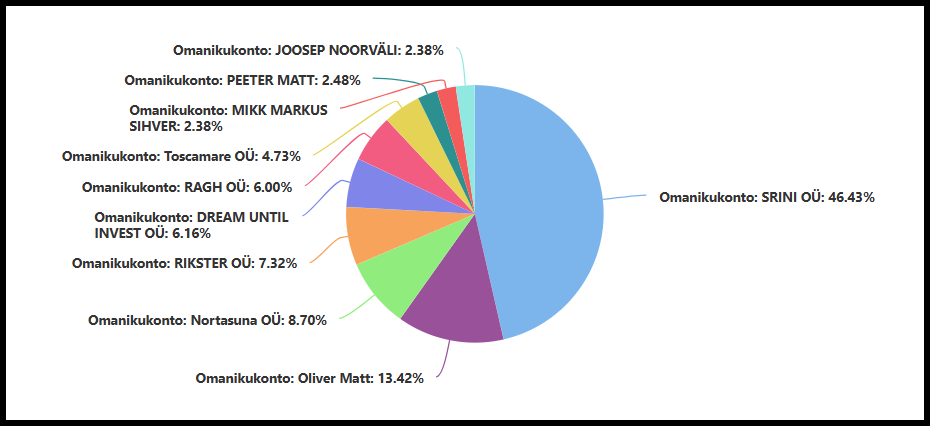
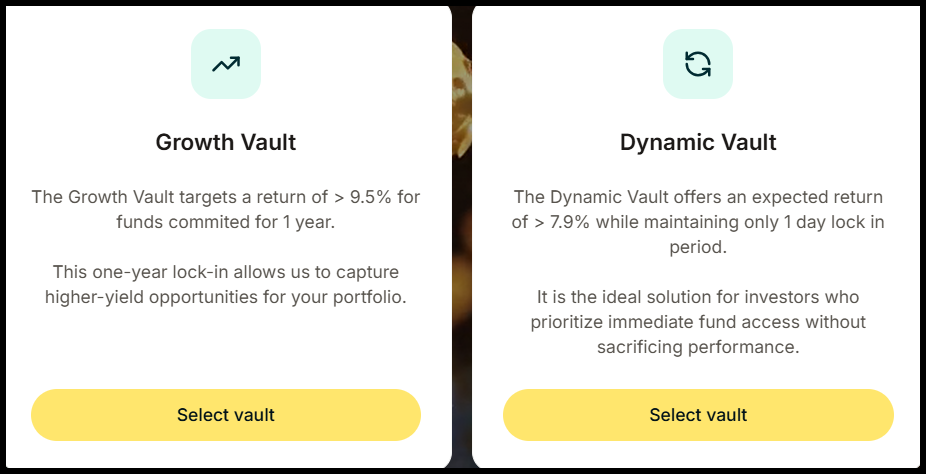
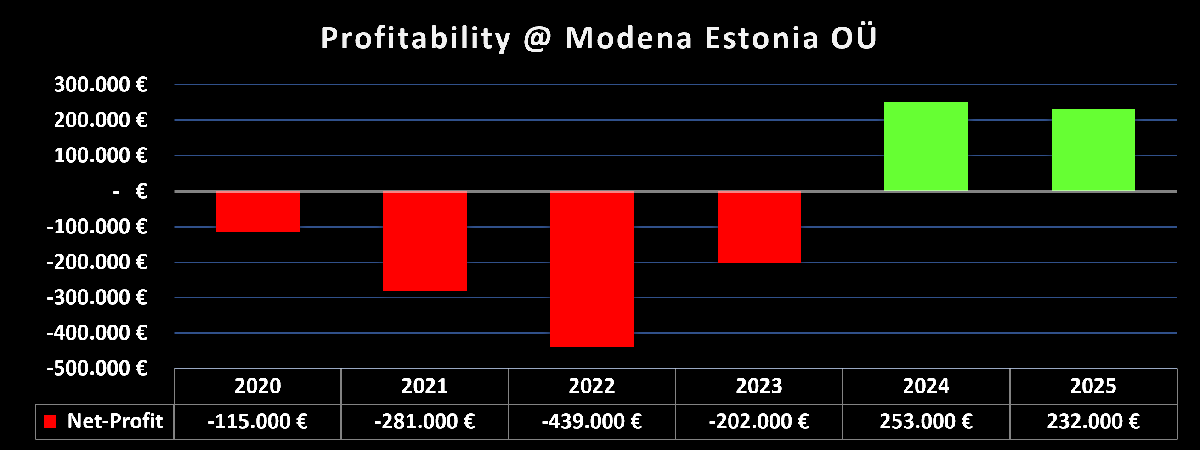
New investors receive a €25 Welcome Bonus after completing their first investment, plus 1% Cashback on the average invested amount during the first 90 days, paid out gradually over the period. The Cashback is capped at €1,000. I have never been invested in Modena with my own funds. The platform meets my evaluation criteria and is therefore generally considered investable. Unlike a classic P2P marketplace, individual loans are not selected. Instead, investors can put their money into one of two automated investment products, which Modena calls “vaults”. Through these, investors acquire fractions of claims that Modena has previously originated against its own borrowers. Modena’s product offering has many similarities to Monefit SmartSaver. On the Estonian P2P alternative, investors can invest in different vaults as well, while the lending business is run by the Creditstar Group behind the platform. Below is a short summary of all the key figures and information about Modena. Modena Estonia OÜ was founded in October 2019 under the name “BuyPlan Estonia OÜ”. In the second quarter of 2020, the operational business started with the purchase of merchant receivables, allowing their customers to pay for purchases 30 days later or in up to three instalments. In January 2021, the company applied for a creditor license, which the Estonian Financial Supervision Authority granted in August 2021. A few days later, the company was renamed “Modena Estonia OÜ”. The first consumer loans were issued in December 2021. In 2024, Modena advanced its plans for launching a P2P lending platform and prepared the necessary infrastructure to resell its claims to external investors. Following an internal testing phase at the end of 2024, the platform went live for investors at the beginning of 2025. How does Modena make money? Unlike classic P2P marketplaces, there are no brokerage fees charged to external loan originators. Modena earns from its own lending business and from the margin on the sale of the claims. According to the platform, the income from the lending business comes from four sources: interest and contract fees on consumer loans (19% to 35% APR), interest and contract fees on business loans (16% to 25%), merchant fees on BNPL contracts (25% to 90%, borne by the merchant), and transaction fees from payment services for merchants (€0.05 to €0.50 per transaction). The business model is now largely funded through the platform itself. Of the total outstanding loan portfolio of €8.7 million, around €7.5 million has been sold to investors on Modena (September 2026). P2P lending is a dynamic asset class where investors should stay continuously informed. You will find the latest news on Modena on my P2P lending news page, where I cover other P2P platforms as well. Alongside Bondora Go & Grow and Monefit SmartSaver, Modena is often mentioned as the third alternative among liquidity-focused investment products. Unlike the other two products, however, Modena has neither a long track record nor a large group behind it driving the development of the platform. So, is it already worth investing in Modena? Based on very open and transparent conversations with CEO Oliver Matt, I have now published a detailed review of the Modena platform, taking an in-depth look at the business model, investment profile, and various risk factors of the Estonia-based company. Modena Review + €25 Bonus: https://rethink-p2p.de/en/modena-review/ Alternatively, you can subscribe to my Telegram channel or WhatsApp group (both free of charge) to receive real-time updates as soon as new developments emerge. Modena Estonia OÜ is 100% owned by the Estonian company Sakari Ventures OÜ. The platform is led by co-founder and General Manager Oliver Matt. Who owns Modena? A look at the Estonian company register reveals that 100% of the shares are held by “Sakari Ventures OÜ”, which previously operated under the name “Modena OÜ”. The shareholder base is broadly spread. According to Modena, the platform is mostly owned by people who work in the company, with only 15.32% held by non-employees. Here is an overview of the current shareholder structure (September 2026): Besides Modena Estonia OÜ, the lender and operator of the Modena platform, Sakari Ventures OÜ also owns Modena Payments OÜ. This is a payment institution licensed since May 2022. There are currently no consolidated group accounts. His career path led from auditing at PwC and the treasury function at Circle K into the lending business. At IPF Digital, the digital arm of the consumer lender International Personal Finance, he was responsible for the credit and risk systems across seven European markets as well as Mexico and Australia from 2015 to 2020. He then briefly served as Chief Product Officer at the Estonian consumer lender ESTO. According to the platform, Modena’s team consists of 15 people. To register with Modena, the following requirements must be met: The registration process is simple and intuitive. After opening an account via email address, identity verification takes place through the provider Veriff. You then need to provide information on the source of funds and confirm that you are the beneficial owner and not a politically exposed person. Deposits and withdrawals are only possible in euros and via an account within the EEA held in your own name. The portal is currently only available in English, and there is no mobile app. New investors receive a €25 Welcome Bonus after completing their first investment, plus 1% Cashback on the average invested amount during the first 90 days, paid out gradually over the period. The Cashback is capped at €1,000. A platform overview with all bonus offers and cashback promotions can be found on the bonus page. On Modena, investors invest from €50 through two automated vaults. There is no individual loan selection, no Auto Invest in the classic sense and no secondary market. Modena issues loans exclusively in Estonia. Through the vaults, investors automatically receive fractions of a pool of consumer loans, credit lines, refinancing loans and BNPL receivables. According to the platform, the borrowers are predominantly Estonian private individuals and small and medium-sized enterprises between 25 and 60 years of age. The average loan amounts range from €500 to €15,000 for consumers and from €10,000 to €50,000 for businesses. According to the annual report, the contractual interest rates range between 8.9% and 38.5% per year. Important for context: investors always acquire only a fraction of a claim and therefore do not become the sole creditor of the borrower. The assignment agreement explicitly states that the acquired claim does not rank ahead of the claims of other creditors under the same loan agreement. Modena currently offers two investment products, each with a different strength. The Dynamic Vault is designed for liquidity. Modena states an expected return of more than 7.9% with a minimum holding period of just one day. Withdrawal requests are processed as a buyback, while the money is usually available the following day. However, this timeframe is not contractually guaranteed, more on that in the section on the secondary market. The Growth Vault offers the higher return with a target of more than 9.5%, but locks up the capital for one year. A minimum investment of €50 applies to both vaults. According to the published price list, Modena has not charged any fees for account management, deposits or withdrawals since 1 January 2024. Therefore, there are currently no costs for investors. The assignment agreement, however, contains two types of fees that Modena can introduce with 30 days’ notice. Firstly, a “platform fee”, which is withheld as a percentage of each debtor’s payment, and secondly an “inactivity fee”. The latter would be charged monthly if an investor no longer holds any claims but still has a balance in the account. The homepage advertises an annual return of up to 11%. This maximum return can be achieved by using the Growth Vault. The actual discount rate depends on the actual claim, but on average investors can expect a return of around 10% p.a. On the platform’s own statistics page (September 2026), an average annualised return of 9.31% is reported, calculated on the basis of the last three months. As with many other P2P lending platforms, Modena also has a buyback mechanism. If a borrower falls into arrears, Modena can buy back the affected claim from the investor. According to the platform, this happens after 35 to 90 days depending on the contract type, while the assignment agreement already permits a buyback from more than 30 days. The buyback is serviced directly from Modena’s own balance sheet. The assignment agreement communicates further details on the buyback. It makes clear that the buyback is a right and not an obligation on Modena’s side. In this case, the buyback price amounts to at least 75% of the outstanding principal. The same floor of 75% also applies in three further cases: if the investor revokes the power of attorney granted to Modena, in the event of an early termination of the agreement, and if an authority or applicable law requires it. Investors only receive 100% of the outstanding principal if Modena exercises the buyback at its own discretion. Investors should bear in mind that the exercise of the buyback is directly tied to the creditworthiness of Modena Estonia OÜ. Modena states the average buyback rate over the last twelve months at 1.96%. There is no Auto Invest feature on Modena in the classic sense, nor is one required. The vaults handle allocation, diversification and reinvestment fully automatically. Which specific claims are allocated is decided by Modena at its own discretion. A special feature of the platform is the automatic payout. Using a slider, investors can define what share of the monthly earnings is transferred to their own bank account, while the rest remains invested. The payout takes place on the third business day of the following month. There is no secondary market on Modena. Under the contractual framework, investors may only sell their claims back to Modena and may neither transfer nor pledge them otherwise. To do so, the investor submits a sell order and states the amount they wish to receive. Modena reviews this order within 14 calendar days and has the right to execute it in full, in part or not at all. Generally, interest income generated through loan financing is considered capital income and thus must be declared as such in the tax return. Estonia does not levy withholding tax on the interest paid out by Modena. Investors therefore receive their earnings gross and are themselves responsible for declaring them in their country of residence. Compared with platforms from Latvia or Lithuania, where withholding tax is retained, this is a structural advantage. For the tax return, Modena provides earnings and cash flow statements as well as a dedicated tax report in the portal, which can be filtered by vault and period and exported. The main risk with Modena is the concentration on a single company, as the platform, the lender and the buyback counterparty are identical. On top of that come an unregulated investment product and a lack of segregation of investor funds. The operational launch of the investment platform, which is operated by the Estonian company “Modena Estonia OÜ”, took place at the beginning of 2025. In its domestic market, the company is supervised by the Estonian Financial Supervision Authority (Finantsinspektsioon). No Red Flags present. In January 2021, Modena applied for a creditor license, which was granted by the Estonian Financial Supervision Authority in August 2021. This license covers the issuance of consumer loans and primarily serves consumer protection and anti-money laundering on the borrower side. It does not provide any investor protection. Modena itself provides the reasoning for this. The company is neither a crowdfunding platform nor a deposit-taking institution. Instead, investors acquire claims that originate from Modena and belong to Modena, which is why a crowdfunding license under EU law is not required. The assignment agreement and the legal notice on the website also point out that the contractual relationship is not to be interpreted as crowdfunding, deposit-taking, a payment service or an investment service. For investors, this means that there is no entitlement to compensation through an investor compensation scheme, that there are no regulatory compliance and transparency standards enforced for the investment product, and that there is no obligation to publish audited annual reports. The homepage advertises that investor funds are held in segregated accounts. On closer inspection, the situation looks somewhat different. The account holder is Modena Estonia OÜ itself, meaning the same company that sells the claims. As soon as an investor deposits money, claims are allocated to them almost immediately, so that legally the funds are replaced by the ownership of those claims. What remains attributable to the investor is only the deposited but not yet invested balance, which Modena puts at 2% to 4% of the capital. A dedicated bank account is used for this share, but according to Modena there are no further legal safeguards in place. The reasoning behind this is remarkably candid: together with lawyers, the company examined various structures but always arrived at the same conclusion, namely that Modena, as the commissioning party of all service agreements, could also circumvent any protective structure it set up itself. Rather than a solution that looks good on paper but offers no actual protection, the company decided against it. Investors are advised not to leave balances sitting unused anyway. This reasoning is understandable and more honest than what is stated on the homepage. The consequence remains the same: a segregation of funds in the sense of investor protection does not exist at Modena. In addition, the investments offered via Modena are not covered by a national or European deposit protection scheme. Investors should therefore be aware that the invested capital is subject to a real risk of loss, that returns are not guaranteed, and that they may not get back the full invested amount. The financial stability of a P2P platform is a key risk factor. Can Modena already operate profitably? And what conclusions can be drawn from the balance sheet? Annual Report Auditor: Audit Advisory OÜ Regulated audit firm. Standard: Estonian GAAP Local standard, not internationally comparable. Modena publishes audited annual reports, even though there is no regulatory obligation to do so for the investment product. The 2025 accounts were audited by Audit Advisory OÜ, the previous year’s accounts by AVAC Audit OÜ. Both audit opinions were issued unqualified. The accounting standard is the Estonian financial reporting standard for small companies, not IFRS. Modena generated a profit for the first time in 2024 and confirmed this in 2025 with €231,943. The years before that were consistently loss-making. Two remarks on this. Firstly, the profit originally reported for 2024 of €368,085 was restated to €253,097 in the following year, after Modena had refined its methodology for assessing credit losses. And secondly, in 2025 a total of €239,619 in own personnel costs was capitalised as internally generated software. Without this capitalisation, the result would have come to minus €7,676. The equity ratio stands at 20.6%, the debt ratio at 3.86 and the liquidity ratio at 1.59. Compared with the previous year, all three figures have improved. A look back at 2023 does put this into perspective. At that time, the equity ratio still stood at 63.1%. The drop in the following year goes back to a single transaction: a capital reserve of €2 million, previously contributed by a related party, was converted back into a loan in 2024. Equity fell as a result from €2.60 million to €0.96 million, even though the year closed with a profit. Investors should also pay attention to the composition of the balance sheet. Of the current €1.08 million in equity, €0.90 million consists of capitalised software. The tangible equity therefore amounts to only around €181,000. Modena is both the platform and the sole lender. Anyone investing on the P2P platform therefore carries the risk of a single Estonian company. For the credit assessment, Modena uses a multi-stage process. Through the group-owned Modena Payments OÜ, the applicant’s bank data is analysed as part of an account information service, among other things for regular salary payments, existing obligations, payments to debt collection agencies and bailiffs, as well as conspicuous payments to gambling providers. This is complemented by checks with several credit bureaus, screenings with anti-fraud service providers and a self-assessment by the customer. As affordability limits, Modena states that no more than 50% of the official income may be spent on financial services and that the income must exceed living costs plus financial obligations and a ten percent buffer. Recoveries are handled without an external debt collection agency. Instead, new instalment arrangements are agreed first, or, in case of doubt, the matter goes directly to court. Modena does not publish any arrears or default rates on its statistics page. On request, however, the platform discloses the figures in full (September 2026), which is by no means a given in the current market environment. With an NPL ratio of 8%, Modena sits within the normal range for unsecured consumer lending. In addition, both default rates move within the platform’s own target corridors. According to the platform, the recovery of defaulted loans reaches 51% of the claim within twelve months, 65% within 24 months and 75% within four years. In the end, this leaves a loss of around one quarter of the defaulted claims. What matters for investors is where these defaults end up. Loans in arrears leave the investor portfolio through the buyback and remain with Modena. Of the loan portfolio of €8.7 million, around €7.5 million has been sold to investors, which means that the bulk of the €0.7 million in non-performing claims sits on Modena’s own balance sheet. Measured against equity of €1.08 million, this is a considerable share. This construction only holds as long as Modena can shoulder the buybacks under its own steam. From 20 November 2026, the new EU Consumer Credit Directive (CCD II) applies. For the first time, interest-free instalment payments, BNPL models and small loans below €200 will fall under consumer credit law, including a mandatory creditworthiness assessment and extended information duties. This hits Modena at the core of its new business. Of roughly €2.1 million in monthly loan issuance, around €1.5 million is BNPL, with an average contract value of €200. Management expects that the product cannot be continued in its current form and anticipates a volume decline of around 50%. For the investment product, the direct effect is manageable. Due to the short terms, BNPL accounts for only €0.8 million of the €8.7 million portfolio. The claims in the vaults, on the other hand, predominantly come from the lending business. Indirectly, it weighs more heavily. BNPL is also Modena’s most important customer acquisition channel, through which around 23,000 new customers came into the company in 2024. And the 2025 profit of €231,943 leaves little room for revenue shortfalls, especially as it rests entirely on the capitalisation of internally generated development work. A decline therefore hits exactly the balance sheet that also carries the buyback. On the other hand, Modena already holds a creditor license and an established assessment process. The additional effort is likely to be lower than for pure BNPL providers coming under supervision for the first time. A consolidation of the Estonian market could therefore also bring Modena additional market share. In this section, I have listed what I consider to be the most important advantages and disadvantages of the P2P lending platform, based on my Modena review so far. What is the preliminary conclusion of my Modena review so far? Modena is one of the most forthcoming newcomers in the P2P lending market. The platform publishes audited annual reports even though it is not required to, provides the assignment agreement on request and discloses default and recovery rates. The explanation of why it decided against a structure for segregating funds is more honest than what most competitors deliver at this point. Precisely this openness, however, shows how far the marketing and the contractual reality diverge. On one hand, the buyback is merely a contractual right with a floor of 75% of the principal. On the other, the segregated accounts offer investors no legal protection, since the account holder is Modena itself. Whether an investment is worthwhile depends primarily on your personal strategy and risk tolerance. Anyone who values the monthly payout feature and is prepared to carry the risk of a single Estonian lender without regulation, without segregation of funds and without an enforceable buyback entitlement can consider Modena as a small addition. As a core position in a P2P portfolio, the platform is in my view currently not suitable. New investors receive a €25 Welcome Bonus after completing their first investment, plus 1% Cashback on the average invested amount during the first 90 days, paid out gradually over the period. The Cashback is capped at €1,000. Already invested with Modena? Or looking for similar platforms? Here are three Modena alternatives from the current P2P market environment. Monefit SmartSaver: The structurally closest product. Also based in Estonia, also unregulated and also a refinancing instrument for the lending business of the parent group (Creditstar Group). Unlike Modena, however, it is backed by a considerably larger and longer-established lending group. More information in my Monefit SmartSaver review. Bondora Go & Grow: The best-known one-click product in Europe, with a fixed target return, daily availability and a considerably longer track record. The return is lower than at Modena, but the platform is far larger and has been on the market much longer. More information in my Go & Grow review. Income Marketplace: An unregulated P2P marketplace based in Estonia which, unlike Modena, works with several external loan originators and secures them through additional safety mechanisms. For investors looking for diversification across several lenders, this is the more consistent choice. More information in my Income Marketplace review. You can find more Modena alternatives in the P2P Platforms Comparison. Modena is a P2P lending platform based in Estonia, operational since the beginning of 2025, on which investors can invest in consumer loans through two automated investment products (vaults). It is operated by Modena Estonia OÜ, a lender licensed since August 2021. The advertised return is up to 11%. No, at least not the investment product. Modena Estonia OÜ holds a creditor license from the Estonian Financial Supervision Authority, which covers the lending business towards borrowers. Modena itself makes clear that it is not a crowdfunding provider and that user funds are not deposits. There is no investor compensation scheme and no deposit protection. Modena refers to the mechanism as a buyback guarantee, but the assignment agreement grants the platform a right and not an obligation. After more than 30 days of arrears, Modena can buy back the claim, at a price of at least 75% of the outstanding principal. Investors only receive 100% if Modena exercises the buyback without a specific trigger. There is no provision fund. The advertised return is up to 11% per year, depending on the chosen vault. The platform’s own statistics page reports an average annualised return of 9.31% in September 2026, calculated on the basis of the last three months. Modena itself states an average expectation of around 10% per year. No, the agreement explicitly excludes one. Claims may only be sold back to Modena. To do so, the investor submits a sell order, which Modena reviews within 14 calendar days and may execute in full, in part or not at all. In practice, payouts from the Dynamic Vault are usually made the following day, but there is no contractual entitlement to this. I’m Denny Neidhardt, the founder of re:think P2P. On this blog, I help retail investors make smarter, well-informed investment decisions in the world of P2P lending. Since 2019, I’ve been publishing in-depth analyses, platform reviews, and risk assessments to bring more transparency to this investment space. My goal is to challenge marketing claims, question developments, and empower investors with honest, independent insights.
What is Modena?
 Modena is a P2P lending platform based in Estonia on which investors can invest in consumer loans and earn a return of up to 11%.
Modena Fact Sheet
Founded / Launched:
October 2019 / Beginning of 2025
Legal Name:
Modena Estonia OÜ (LINK)
Headquarter:
Tallinn, Estonia
Regulated:
No (Creditor License)
CEO:
Oliver Matt (April 2021)
Assets under Management:
EUR 7.8+ million
Number of Investors:
6,600+
Return:
Up to 11%
Safety Score:
5.6 / 10 (Rank 18 of 31) | View Methodology
Primary Loan Type:
Consumer Loans
Collateral:
Buyback Right (from 30 days)
Origin Story
Business Model
Modena News
Shareholders and Management
Modena Shareholders
Modena Management
 The company is led by Oliver Matt, who has been on the management board since April 2021 and, as General Manager, is responsible for strategic development and the product. With 13.42%, he is also the largest directly invested private individual.
Sign Up and Bonus
Modena Bonus
Investing with Modena
The Loan Offering
Dynamic Vault and Growth Vault
Costs and Fees
Return
Buyback Guarantee
Auto Invest and Secondary Market
Modena Taxes
Modena Risk
Platform Risk
Red Flags 0
Regulation and License
Segregation of Funds and Deposit Protection
Financial Stability
Profitability
Balance Sheet
Lender Risk
Portfolio Quality
Metric
Value
Total portfolio
EUR 8.7M
of which loans
EUR 7.2M
of which BNPL
EUR 0.8M
of which non-performing
EUR 0.7M
Default rate loans
6.3% (target: 5% to 8%)
Default rate BNPL
1.7% (target: 1% to 2%)
Monthly loan issuance
EUR 2.0M
Regulatory Outlook: CCD II
Advantages and Disadvantages
Summary: Modena Review
Modena Alternatives
FAQ Modena Review


Modena Review 2026
Last Update: 29 September 2026
★★★★★
(3.4)
New Investor Bonus
Skin in the Game
28. September 2026
★★★★★
(3.4)
New Investor Bonus
Safety Score
Rank 18 of 31
5.6
/ 10
Medium Risk
Regulation and Licensing
0 / 15
Financial Stability
15 / 20
Transparency and Disclosure
8 / 15
Loan Portfolio and Investor Losses
25 / 25
Track Record and Crisis Behaviour
8 / 25
The Safety Score assesses platform risk only. Lender risks and country-specific risks are not covered and must be evaluated separately.
★★★★★
(3.4)
New Investor Bonus
Affiliate Links / Conflict of InterestDisclaimer
This article contains affiliate links. If you register and/or invest through one of these links, the operator receives a commission. The compensation has no influence on the opinion or the evaluation of the platform. Potential conflicts of interest can be looked up on the “P2P Portfolio” page.
Investments in P2P loans involve risks and may result in the complete loss of the invested capital. Past performance is not a reliable indicator of future developments. The following content is provided for informational purposes only and does not constitute investment advice. Despite careful research, no guarantee is given for the accuracy, completeness, or timeliness of the information provided. No liability is accepted for any financial losses or investment decisions made based on the information presented here. For more details, see the full disclaimer.
✅ What is Modena?
✅ Is Modena regulated and safe?
✅ Is there a buyback guarantee offered by Modena?
✅ What return can I expect with Modena?
✅ Is there a secondary market?
Do you invest in Modena?
No, not yet. The skin in the game box at the top of the Modena review reveals if I am actively invested on the platform.